

The camera industry isn’t what it once was, I think we can all agree. The 6.5 million interchangeable lens cameras shipped by CIPA members last year represented a 50% fall in sales volume since the high, back in 2010, while the 1.9 million fixed lens cameras represented a fall of 98%.
Despite this, most of the companies competing in the industry back in 2010 are still present, and those we’ve spoken to this year sound more upbeat than they have in a while. Because, while the base is much smaller, ILC shipment volumes in the first ten months of 2025 are 11% up, compared with last year and fixed lens camera sales are up by around 26% over 2024.
Which is to say that there still appears to be a market for cameras, but it’s a very different world to the one of fifteen years ago, when a majority of people bought cameras. Now the industry caters to a smaller audience: photographers, vloggers and people who specifically want a dedicated camera, because most people have a perfectly capable phone when they want to take pictures.
I don’t remember the last time we saw so much invention, experimentation or niche-tickling lunacy as we’ve seen in 2025
I’m going to argue that the result has been perhaps the most interesting year for cameras in the eighteen years I’ve been covering the industry. There have been countless excellent cameras in that time, and a whole host of interesting ones, but I don’t remember the last time we saw so much invention, experimentation and niche-tickling lunacy as we’ve seen these past 12 months.
 |
| The Ricoh GR IV isn’t included in this article, despite being a knowingly niche product, because it’s a niche that’s been proven to exist.
Photo: Richard Butler |
We’ve had the sensible cameras, of course, with all the biggest players refresh their mid-priced do-everything cameras with devices that can go toe-to-toe with the pro sports models of just a few years ago, while simultaneously producing higher-than-broadcast video footage, at least for short periods. But while the Panasonic S1 II, Canon EOS R6 III and Sony a7 V bring almost unimaginable levels of performance and capability to a comparatively affordable price point, there have also been a wealth of weird cameras that aren’t trying to be do-it-all multi-tools.
Look at some of this year’s releases through a pragmatic lens of whether they’re the best tool for the job, and the conclusion you’d typically draw is “no.” These aren’t cameras trying to be the best, the most flexible or the most practical. They’re intentionally, knowingly niche cameras, and if they don’t appeal to you, that might not be by accidental. Not all of them succeed in their ambitions, but just because they don’t make sense to you, don’t assume they’re a mistake.
Sony RX1R III
 |
| The RX1R III was castigated for being a lazy update, despite addressing the biggest problem with its predecessor (albeit very belatedly). When I was using it, or looking at the photos it took, I didn’t cross-examine myself about whether my expected level of developmental diligence had been met. |
The Sony RX1R III doesn’t seem too unusual on the face of things: it’s the fourth in a series of high-end photographers’ compacts, previous versions of which built up a strong following. And yet the belated update to the series was met with derision, bordering on anger. A wince-inducing price tag and technology shared with much lower priced models didn’t help, along with the re-use of a lens that doesn’t necessarily make full use of its new, higher resolution sensor or, at least, not at close focus distances and wide apertures. It’s so lazy, critics howled.
And yet, in use, it’s excellent. It’s the smallest fixed-lens full-frame camera you can buy, it’s so single-minded in its purpose (photos shot at 35mm focal length) that it’s much nicer to use than the likes of the a7CR, with which it shares so many components. It’s small, fun to use and the pictures look great, because it turns out that biting sharpness isn’t always what you want from a lens. It also turns out that the amount of perceived effort put into a camera has nothing to do with how good it is. It is really, really expensive, but if you’re the kind of person it’s aimed at (and I am), it’s really, really good.
Leica Q3 Mono
 |
| It has an excellent sensor, great lens and is superbly built, but I still wonder whether the total audience for a $7800 fixed-lens full-frame compact that can’t comprehend chrominance could all fit on a double-decker bus. |
Then we have the Leica Q3 Monochrom, which is essentially Ginger Rogers to the Sony’s Fred Astaire, in that it does everything the RX1R III does, but more expensively and in mono. Has there ever been a camera aimed at a smaller audience than a $7800 fixed-lens full-frame camera that can’t perceive color? I joked that Leica probably already knows the names of the people who’ll buy it. But those buyers will get a fabulous camera that’s fast, focused and fascinating to shoot with and yes, that stabilized lens is sharper than the Sony’s. It’s not for me, but again, I’m delighted it exists.
Fujifilm GFX100RF
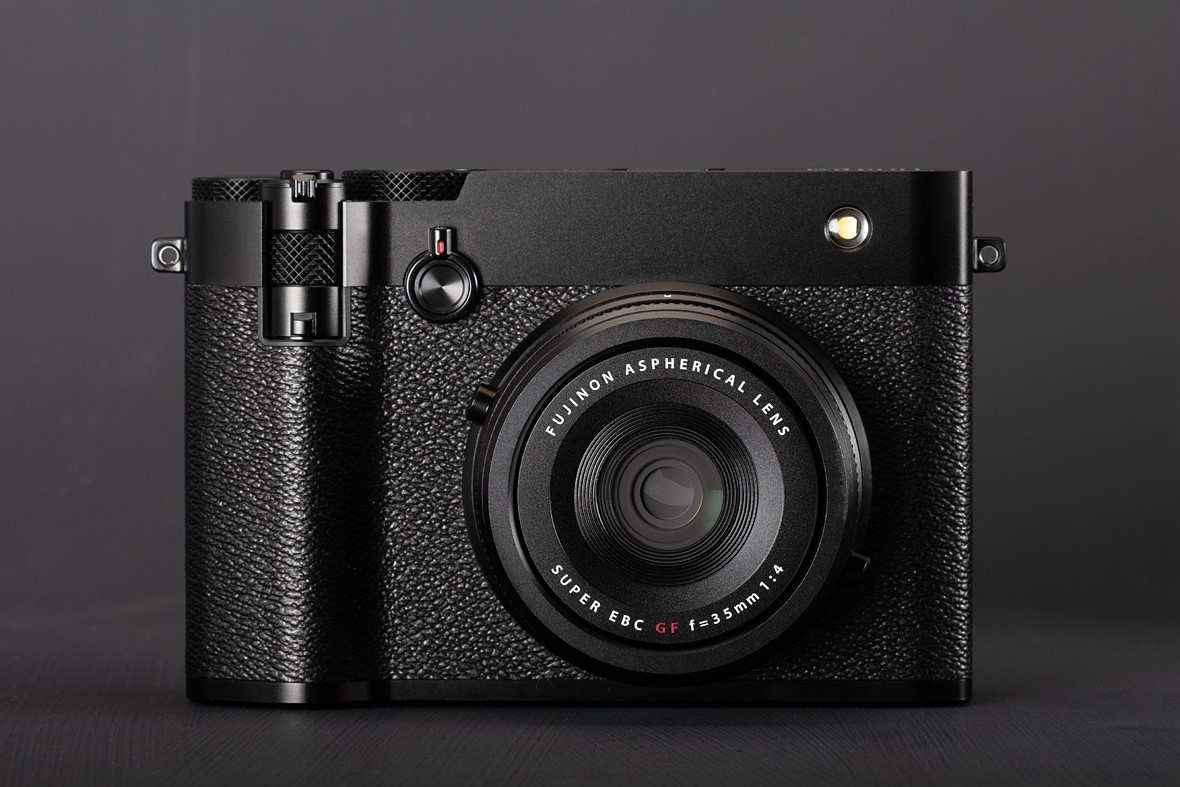
Likewise the Fujifilm GFX100RF. People have been asking for a “medium format X100” for years, and this year Fujifilm didn’t make them one. Instead it introduced a camera with a wider-angle lens, with the X100 series’ hybrid viewfinder and with styling seemingly borrowed from its Instax range. The lens is comparable, in equivalent terms, to the X100’s and there’s no image stabilization, so it’s potentially less capable in the dark, but in good light it’ll deliver better image quality than anything else this portable. There’s an aspect ratio dial with settings so complex that you can’t actually see all of the etching. In principle it’s a less practical option than Leica’s Q3 (and how often is Leica the practical choice?). But it adds an option that’s never existed before.
Fujifilm X half
 |
| Better to be a heroic failure than to not try. Which has been the rest of the industry’s response to youthful demand, so far. And no, adding Raw wouldn’t have made it better.
Photo: Richard Butler |
On which note: the Fujifilm X half, another contender for the title of the DPReview commenters’ least favorite cameras of 2025. And I understand why: it looks like it’s almost the sort of camera many of us have been asking for: a small, pretty, enthusiast compact. But that not what it is at all. Instead, it’s a decidedly un-self-serious attempt to make a camera for young people who’d otherwise be buying an old compact on eBay. It’s fun, it’s silly, it’s nostalgic for a confused idea of a past that never existed. Unfortunately it’s also (and this was 2025’s other prevailing trend) really quite expensive. In practice, I was disappointed by its lack of responsiveness and its disappointing IQ, given how large a sensor it has, but isn’t it better to heroically fail than to not even try?
Sigma BF
 |
| The Sigma BF is an utterly original take on what a picture-taking device should look like and how it should operate. Just in case there’s someone that doesn’t want a black lump that looks like it wants to be a late 80’s SLR when it grows up.
Photo: Richard Butler |
And yet, it’s perhaps not the least ‘serious’ camera launched this year. That title probably goes to the Sigma BF, a profoundly original attempt to make a desirable photo-taking device for people who wouldn’t otherwise buy a camera. It’s undeniably stylized, almost to the point of impracticality, it’s also built with a sensor that doesn’t naturally lend itself to use without a shutter mechanism, which essentially rules out the chance of using flash. But it’s also designed – rather well, I’d argue – to be operated with a single dial and without a viewfinder, which seems to have agitated the kind of people who are presumably dissatisfied with the many, many multi-dial, viewfindered cameras that remain available.
It’s a response I don’t really understand. Yes, SLR-shaped cameras with multiple dials will probably excel in a wider range of situations than this oddball bunch. But this off-beat gang are being offered in addition to the sensible, pragmatic, do-everything cameras. In many instances, I suspect some of these stranger models will live alongside those quotidian powerhouses for many photographers.
We’ve seen some incredibly capable cameras this year, to the point we found it almost impossible to choose a camera of the year. I don’t think anyone’s saying these are better than those options, or that the likes of the Sigma BF is going to usurp them. But, having spent years reading comments asking why camera makers don’t make cameras for photographers, it seems inexplicable to complain when they try to do something interesting and different. And I’d argue that, collectively, these cameras shows a spirit of invention and experimentation we’ve not consistently seen since the very early days of digital photography. In their own, sometimes peculiar, ways these might be the photographer-focused cameras we’ve all been hoping for, even if that specific photographer isn’t always us.






Leave a Reply